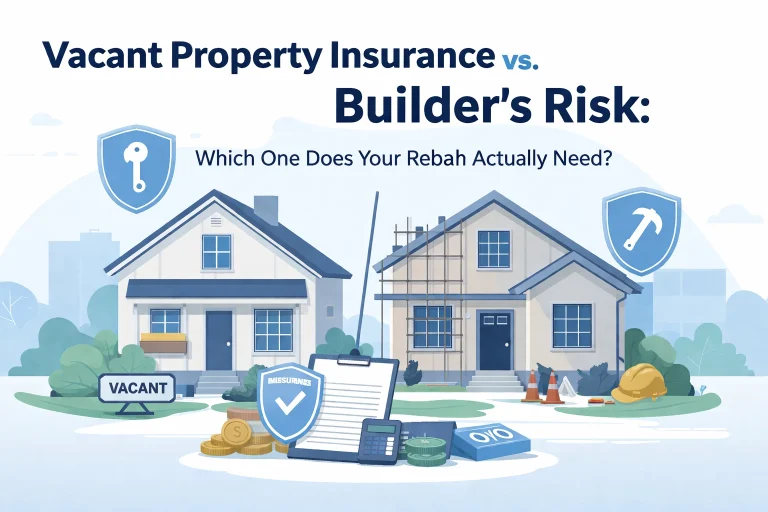
You just closed on a distressed property. The previous owners left months ago, place needs serious work, and you’re ready to start your rehab. But when you call your insurance agent, they hit you with a question that stops you cold: Do you need vacant property insurance or builder’s risk insurance?
Pick wrong, and you could find yourself with a denied claim when a pipe bursts, vandals strike, or a fire tears through your project. The difference between these two policies isn’t just semantics. It’s the difference between financial protection and financial disaster.
Let’s break down exactly which coverage your rehab project actually needs.
Builder’s risk insurance and vacant property insurance serve different purposes. Understanding the distinction comes down to one critical factor: what you’re protecting.
Builder’s risk insurance (also called course of construction coverage) is designed for new construction projects. It protects materials, fixtures, and equipment during the building phase. Think ground-up builds, tear-downs to the foundation, or complete reconstructions where no existing structure remains.
Vacant property insurance protects existing structures while they sit unoccupied. It’s built for properties between uses: including extended renovation work on existing buildings. This coverage addresses risks like vandalism, theft, weather damage, and liability while you’re not physically present.
For most residential real estate investors doing rehab projects, vacant property insurance is the correct choice. You’re renovating an existing structure, not building from scratch.

If you’re doing any type of renovation where the original structure remains, you need vacant property insurance. This includes:
The moment a property sits empty, standard homeowners or landlord policies typically exclude coverage. Most carriers define “vacant” as unoccupied for 30-60 days. Once you cross that threshold, claims for vandalism, theft, water damage, and other common rehab-project disasters get denied.
Vacant property insurance fills that gap. It’s specifically designed for the realities of investment properties: extended timelines, no on-site occupants, and the elevated risks that come with both.
Builder’s risk insurance becomes the appropriate choice in limited scenarios:
Here’s where investors get tripped up: builder’s risk policies have strict limitations for vacant properties. Most only cover vacant buildings for 45 days at the start of a project if construction gets delayed. If your permits take longer than expected or your contractor pushes back the start date, coverage can lapse entirely.
For the typical fix and flip insurance situation, builder’s risk creates more gaps than it fills.

Not sure which direction to go? Run through this checklist:
Choose vacant property insurance if:
✅ The existing structure remains standing during your project
✅ You’re renovating rather than rebuilding from scratch
✅ Your project timeline extends beyond 45 days
✅ The property will sit unoccupied during work
✅ You’re doing cosmetic updates, system replacements, or interior gut renovations
Choose builder’s risk insurance if:
✅ You’re tearing down to the foundation or building new
✅ There’s no existing structure to insure
✅ Your construction timeline is predictable and relatively short
✅ You’re working with a general contractor who may carry their own builder’s risk policy
Most residential real estate investors fall squarely into the first category. The rehab projects that make financial sense: distressed properties, outdated rentals, cosmetic flips: involve existing structures that need vacant property coverage.
Choosing the wrong policy isn’t the only way to end up without coverage when you need it most. Watch out for these frequent missteps:
Assuming your policy covers vacant properties. It doesn’t. Standard homeowners policies leave real estate investors exposed in multiple ways, and vacancy exclusions are among the most common.
Letting coverage lapse between closing and renovation start. The day you close, you own the risk. If you’re waiting on permits, contractor availability, or financing for the rehab, the property still needs coverage.
Underestimating project timelines. Rehabs rarely finish on schedule. Materials get delayed. Inspectors find issues. Contractors juggle multiple jobs. If your policy has tight timeline restrictions, you could lose coverage mid-project.
Forgetting liability coverage. Property damage isn’t your only exposure. If a trespasser gets injured on your vacant property, you’re potentially liable. Make sure your vacant property insurance includes adequate liability limits.
Not updating coverage as improvements increase value. A property worth $150,000 at purchase might be worth $250,000 after renovation. If your coverage limits don’t reflect that increased value, you’re underinsured.

Not all vacant property insurance policies offer the same protection. When shopping for fix and flip insurance or coverage for your rental rehab, look for these elements:
Some carriers specialize in real estate investor coverage and understand the unique risks you face. Others try to fit investor properties into policies designed for owner-occupied homes. The difference shows up when you file a claim.
Let’s put numbers to the risk. Say you’re three months into a $75,000 rehab on a property you purchased for $180,000. You’ve installed new HVAC, updated electrical, and finished the kitchen. Total investment so far: $255,000.
A fire breaks out. You file a claim. And your insurance company denies it because your builder’s risk policy lapsed after 45 days of vacancy, or your standard landlord policy excludes vacant properties.
You’re now out $255,000 with no path to recovery.
The premium difference between proper coverage and inadequate coverage is measured in hundreds of dollars. The claim difference is measured in hundreds of thousands.
Insurance shouldn’t be the hardest part of your rehab project. The right coverage exists for residential real estate investors: you just need to work with specialists who understand your business.
At RealAssure, we focus exclusively on real estate risks. Our team knows the difference between a fix and flip, a BRRRR project, and a rental turnover. We’ve built specialized programs for residential real estate investors that account for vacancies, renovations, and the realities of investment property ownership.
Whether you need vacant property insurance for your current rehab or want to review your entire portfolio’s coverage, we can help you find the right protection without the runaround.
The time to figure out your insurance isn’t after something goes wrong. Before you start demo on your next project, make sure you have the right coverage in place.
For most rehab projects, that means vacant property insurance: not builder’s risk. Get a policy that matches your actual timeline, covers your increasing property value, and protects against the real risks vacant properties face.
Ready to get proper coverage for your rehab? Request a quote and let’s make sure your next project is protected from day one.